What if I told you that the only thing "artificial" about the diamond on your finger was the GPS coordinates of its birth? If you’re feeling a bit of anxiety about whether lab created diamond rings are actually "real" or just high-end fakes, you aren’t alone. I see it every day at my downtown Toronto studio. You want the brilliance and the prestige of a custom engagement ring, but the conflicting noise about moissanite versus lab diamonds and long-term value is enough to make anyone hesitate.
I realize the pressure to get this right is immense, and you certainly don't want to feel judged for choosing a non-natural stone. In my experience, clients often find that once they see the Master Canadian craftsmanship of a lab-grown stone, the myths simply melt away. I am going to debunk the five most persistent misconceptions I hear in the GTA today. By the time we’re done, you’ll understand the cost-to-quality ratio and feel total confidence in selecting a stone that allows for a larger, more stunning custom design without compromising on integrity.
• Realize that lab created diamond rings are chemically and physically identical to mined diamonds, offering the same sparkle and Master Canadian craftsmanship.
• Understand how a shorter supply chain allows you to secure a larger stone for your budget without sacrificing investment-grade aesthetics.
• Learn why these stones never turn cloudy or yellow; they share the same Mohs scale hardness as natural diamonds for lifelong durability.
• Discover how to select a stone that perfectly complements your skin tone and metal colour during a private session at our downtown Toronto studio.
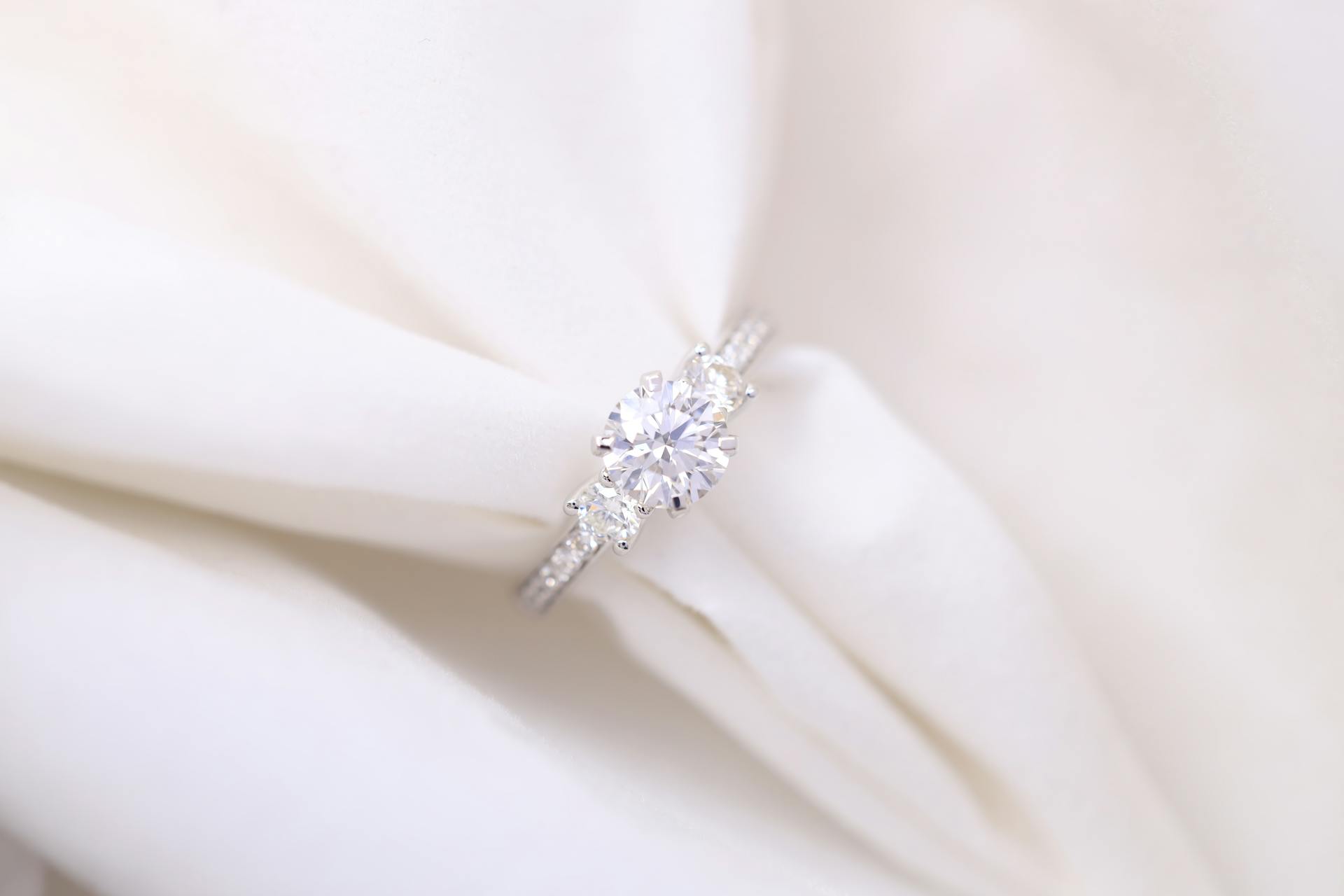
I get this question at my downtown Toronto studio almost every day. The short answer is a definitive yes. A lab created diamond is 100% pure carbon grown in a controlled environment that mimics the intense pressure of the earth's mantle. These are not "simulants" like cubic zirconia or moissanite; they are authentic diamonds with the exact same chemical, physical, and optical properties as those pulled from a mine. When we design lab created diamond rings for our clients, we're using stones that are identical to their mined counterparts in every way that matters.
In my experience, even seasoned jewellers who have handled thousands of stones cannot tell the difference with a traditional loupe. Without specialized laboratory equipment, they look and behave identically. This synthetic diamond overview confirms that the crystal structure is the same. In the 2026 Toronto market, these stones are recognized as technological triumphs, allowing for investment-grade aesthetics without the traditional price tag.
Pro-Tip: The only reliable way to distinguish the two is by checking for a microscopic laser inscription on the girdle. Most reputable lab diamonds are inscribed with a serial number that is invisible to the naked eye, ensuring total transparency about their origin.
It really comes down to the origin story. A natural diamond formed billions of years ago under intense heat and pressure deep within the Earth. A lab diamond follows that same recipe but does it in a highly controlled modern facility. One is a product of geological history; the other is a result of human precision. Both result in a stone that qualifies for Master Canadian craftsmanship when set into a custom piece. You aren't choosing between "real" and "fake," you're choosing between two different ways the earth's most beautiful crystal is formed.
Marketing myths have spent decades clouding the reality of diamond science. For a long time, the industry relied on the "rarity" narrative to justify pricing. Because lab created diamond rings are a more modern entry to the GTA market, some traditionalists use the word "fake" as a defensive tactic. I prefer a more direct approach. Once you realize the carbon bonds are identical, the "fake" label loses all its power. If you want to see the brilliance for yourself, I invite you to book a private consultation at my downtown Toronto studio where we can compare stones side-by-side.
In most industries, a lower price tag suggests a compromise in quality. With lab created diamond rings, the opposite is actually true. The lower cost isn't a reflection of "cheapness" but rather a result of an incredibly efficient, modern supply chain. There are no massive open-pit mines to maintain and far fewer middlemen taking a cut before the stone reaches my hand. This efficiency allows us to focus on the stone's perfection rather than its extraction costs.
I often help clients realize that choosing a lab stone allows them to reallocate their budget. Instead of settling for a smaller, yellowish natural stone, you can secure a larger, higher-colour diamond that is physically identical. Lower cost does not equal lower durability or brilliance. These stones possess the same refractive index and hardness as mined diamonds, meaning they will sparkle just as intensely on your 50th anniversary as they do today.
Pro-Tip: In my experience, the "savings" from a lab diamond are best used to upgrade the cut grade to "Ideal" or "Excellent." A perfectly cut lab diamond will outshine a mediocre natural diamond every single time.
In the 2026 Toronto jewelry market, the value gap has never been wider. Research indicates that lab diamonds currently cost between 70% and 85% less than natural diamonds of comparable quality. For example, while a 2-carat natural diamond might require a significant five-figure investment, a 2-carat lab stone provides that same investment-grade sparkle for a fraction of the cost. This shift has led to the average lab diamond centre stone size in the GTA increasing to nearly 2.5 carats as of 2025.
While the stone is the centrepiece, the setting is what ensures its longevity. Because you're saving on the diamond, more of your investment can go toward the Master Canadian craftsmanship of the ring itself. A high-quality lab diamond deserves a bespoke setting that is structurally sound and aesthetically refined. You can see how we balance these elements in our custom diamond engagement rings gallery Toronto. If you want to see how these stones look in different metals, I'd be happy to help you compare stones during a private session at the studio.
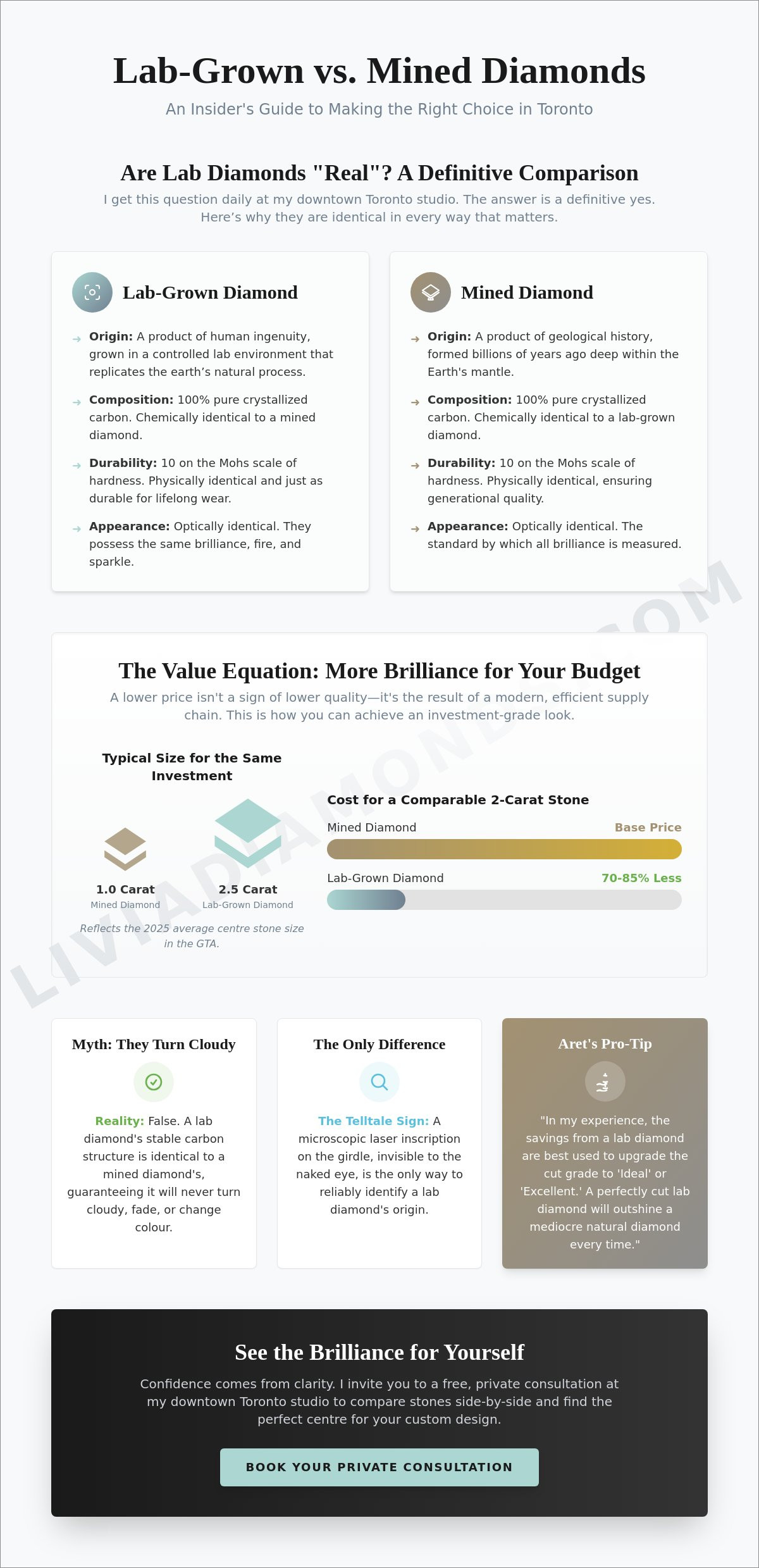
I often hear concerns from couples visiting my downtown studio about whether lab created diamond rings will lose their lustre after a few years. Let’s put that worry to rest. Because lab diamonds are a 10 on the Mohs scale, they are just as hard and durable as any stone pulled from the earth. In all my years at the Toronto studio, I have never seen a lab diamond fade, turn yellow, or spontaneously become cloudy. If a diamond looks hazy, it’s almost always due to a poor cut or excessive fluorescence, not because it was grown in a lab.
Pro-Tip: When you are comparing stones, focus on the "Cut" grade before anything else. A "Super Ideal" or "Excellent" cut is the real secret to lifelong brilliance. It ensures light reflects perfectly rather than escaping through the bottom, which is what often causes that dull, cloudy look people fear.
These stones are permanent. Unlike simulants that can scratch or degrade, a lab diamond is an heirloom-quality piece that will maintain its integrity for generations. Whether you are active with your hands or plan to wear your ring every single day, the stone will not scratch or wear down. We apply the same Master Canadian craftsmanship to these settings as we do for natural stones, ensuring the entire piece is built to last a lifetime in the GTA climate and beyond.
If your ring does start to look a bit dull, it is likely just a buildup of everyday oils, lotions, or soaps. You can easily restore that investment-grade sparkle at home. A simple soak in warm water with a few drops of mild dish soap, followed by a gentle scrub with a soft toothbrush, works wonders. I also recommend a professional check-up at our downtown studio once a year. We can give it a deep ultrasonic clean and ensure the prongs are still secure. If you've noticed your current ring looking a bit tired, book a private consultation and I’ll personally show you how to keep it looking brand new.
Choosing the centrepiece for lab created diamond rings shouldn't feel like a high-stakes math problem. While the technical specifications on an IGI or GIA certificate provide a baseline, they don't tell the whole story. I always encourage my clients to prioritize what their eye actually sees over what is written on a piece of paper. A diamond might have a perfect "paper" grade but lack the life and fire you expect from an investment-grade stone. When we meet, I'll help you select a stone that balances carat weight with the perfect metal colour for your skin tone, ensuring the final piece feels like a natural extension of your style.
Pro-Tip: In my experience, you can often drop one or two grades in clarity if the stone is "eye-clean" and the inclusions are positioned where a prong can hide them. This insider trade-off allows you to allocate more of your budget toward a larger carat size or a more intricate custom setting without any visible compromise in beauty.
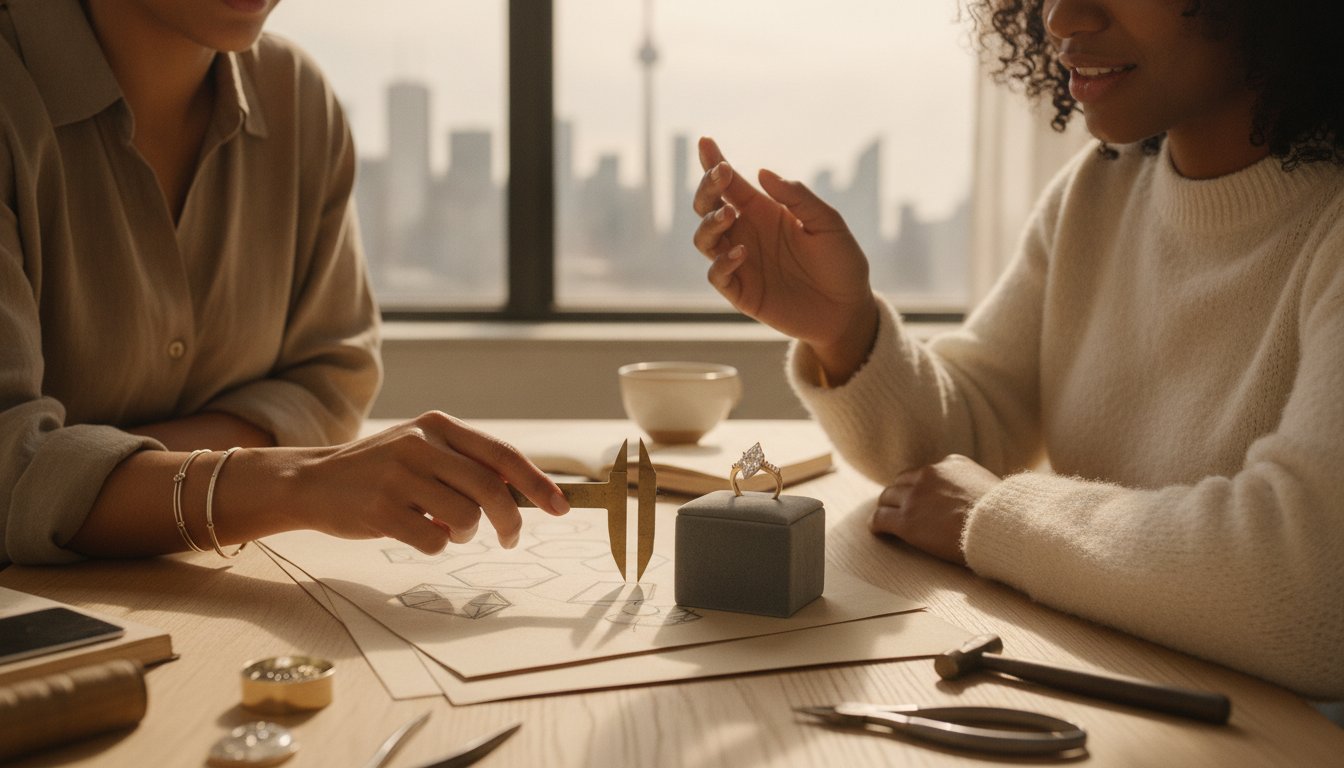
There is a significant difference between scrolling through an e-shop gallery and seeing a diamond perform under different lighting conditions. At my downtown studio, we look at stones together in a relaxed, collaborative environment. You get to see how a specific lab diamond interacts with the light of a Toronto afternoon versus the warm glow of an evening dinner. This hands-on approach is the only way to truly understand the nuance of a stone's personality. You can learn more about what to expect at your Livia Diamonds consultation before you arrive.
My goal is to help you realize your vision without the high-pressure atmosphere of a traditional retail showroom. Designing a custom engagement ring is a journey, and as your guide, I'm here to ensure every detail, from the stone selection to the Master Canadian craftsmanship of the band, is executed with precision. If you are ready to see the brilliance of these stones in person and start the design process, I invite you to book an appointment for a private session. Let's find a stone that fits your budget and exceeds your expectations.
Choosing a stone for your proposal shouldn't be a source of stress. We have dismantled the idea that origin defines reality and confirmed that a shorter supply chain is simply a win for your budget. When we work together, you'll see that lab created diamond rings offer a path to incredible brilliance and investment-grade aesthetics without the traditional markups. My goal is to ensure you feel total confidence in your choice, knowing the science and the craftsmanship are both on your side.
As a third-generation jeweller, I take immense pride in applying Master Canadian craftsmanship to every custom piece I create. I invite you to step away from the digital galleries and experience the fire of these stones in person during a one-on-one session. Book a free private consultation at my downtown Toronto studio to find your perfect lab diamond. Let's take the next step in bringing your vision to life in a space designed for quiet, honest collaboration. You deserve a ring that is as meaningful as the story it represents.
Lab created diamond rings typically do not hold the same resale value as natural diamonds. While they offer massive savings at the time of purchase, the secondary market for lab stones is still evolving. In my experience, clients find the real value lies in the ability to secure a larger stone and a custom setting today. You should view this purchase as a lifelong heirloom rather than a liquid financial asset.
No, a jeweller cannot tell the difference using only a standard magnifying loupe. Even with my years of experience in the Toronto trade, I must use specialized laboratory equipment to identify a lab diamond. To the naked eye and under basic magnification, the stones are indistinguishable. They share the same refractive index and crystal structure; they handle light in the exact same way as a mined stone.
Yes, lab diamonds are graded and certified by the same major institutes as natural stones, primarily the IGI and the GIA. These certificates are non-negotiable for my clients because they verify the cut, colour, clarity, and carat weight. As of 2026, IGI is the industry leader for lab grading, providing a detailed report that ensures you are receiving exactly what you paid for in your custom design.
Lab diamonds perform identically in the bright Toronto sun and under the soft lighting of a restaurant. Because they share the same optical properties as natural diamonds, they don't have a "tell" in different environments. Whether you are outdoors in the GTA or inside my studio, the sparkle remains consistent. The brilliance you see depends on the precision of the cut, which is why I prioritize cut grade above all else.
No, moissanite is a different gemstone entirely and is not a diamond. While lab created diamond rings are made of 100% carbon, moissanite is silicon carbide. This difference in chemistry means moissanite reflects light with a "disco ball" rainbow effect that is quite different from the crisp, white sparkle of a diamond. Most people can spot the difference once they see both stones side by side in my studio.

© Copyright 2023 Livia Diamonds. All Rights Reserved